Canon · Public selection · 16 pages
The Constitutional Canon of the Democratic Quintet towards 2050
The selection prepared for publication introduces the standing, direction and reference points of the consolidated September 2026 edition.



PATRICE LEBON / THE CHAMBER OF IDEAS
Represent. Govern. Restrain power.
Enter a proposal, encounter its objections and advance the debate.
This surrealist composition gives form to a political question: how can rules that appear immutable be opened to discussion?
An artistic metaphor, not a depiction of an actual place or event. This interpretation is offered to the visitor; it does not foreclose a personal reading.
THE DISCIPLINE OF DISAGREEMENT
It deserves scrutiny of its assumptions, assessment of its consequences and an honest search for what might cause it to fail.
The Democratic Quintet is Patrice Lebon’s contribution to reflection on Mauritian institutions. This space sets out its mechanisms and organises possible objections so that their conditions and limits may be discussed.
Proposals offered for debate. None of the mechanisms presented here should be read as current law or as an official position of the Constitutional Review Commission.
01 / THE THEATRE OF ARGUMENT
Choose a question, then change your perspective. The objections below are editorial prompts for discussion, not testimony from participants.
ELECTORAL FAIRNESS / THE CAPACITY TO GOVERN
The proposal
The model seeks to bring the distribution of seats closer to the distribution of votes, then address stability through a separate, limited mechanism.
What simulation result would lead you to judge the mechanism insufficiently representative or excessively unstable?
Prepare a contribution02 / THE PROPOSAL’S ARCHITECTURE
Consolidated Canon · Version 1.0
September 2026
The Canon takes precedence over earlier texts.
FROM THE VOTE TO ACCOUNTABLE POWER
Select a function. The diagram sets out the model’s intention; it does not purport to demonstrate its effects.
A faithful allocation of seats does not, by itself, guarantee either diversity among elected representatives or accountability in the exercise of power.
Put this function to the test
Each fragment represents a voice that retains its individuality within a whole. The image evokes representation; it does not depict a seat-allocation formula or guarantee perfect equality.
A symbolic illustration of the pillar’s purpose. It is not evidence of its effectiveness.THE DEMOCRATIC QUINTET / RPI
An Assembly with a fixed total of 70 seats, including Rodrigues. Seats are first allocated nationally by the modified Sainte-Laguë method, then assigned territorially. The scenario uses a 3% national threshold and the divisors 1.4, 3, 5, 7… Open lists allow electors to express preferences for individual candidates.
Source for the mechanisms · Consolidated Canon, executive summary, §§ 3–7. Thresholds and trade-offs remain proposed choices, to be compared and tested.
 OPEN THE DOCUMENT
THE FULL EXPLANATION / 20 PAGES
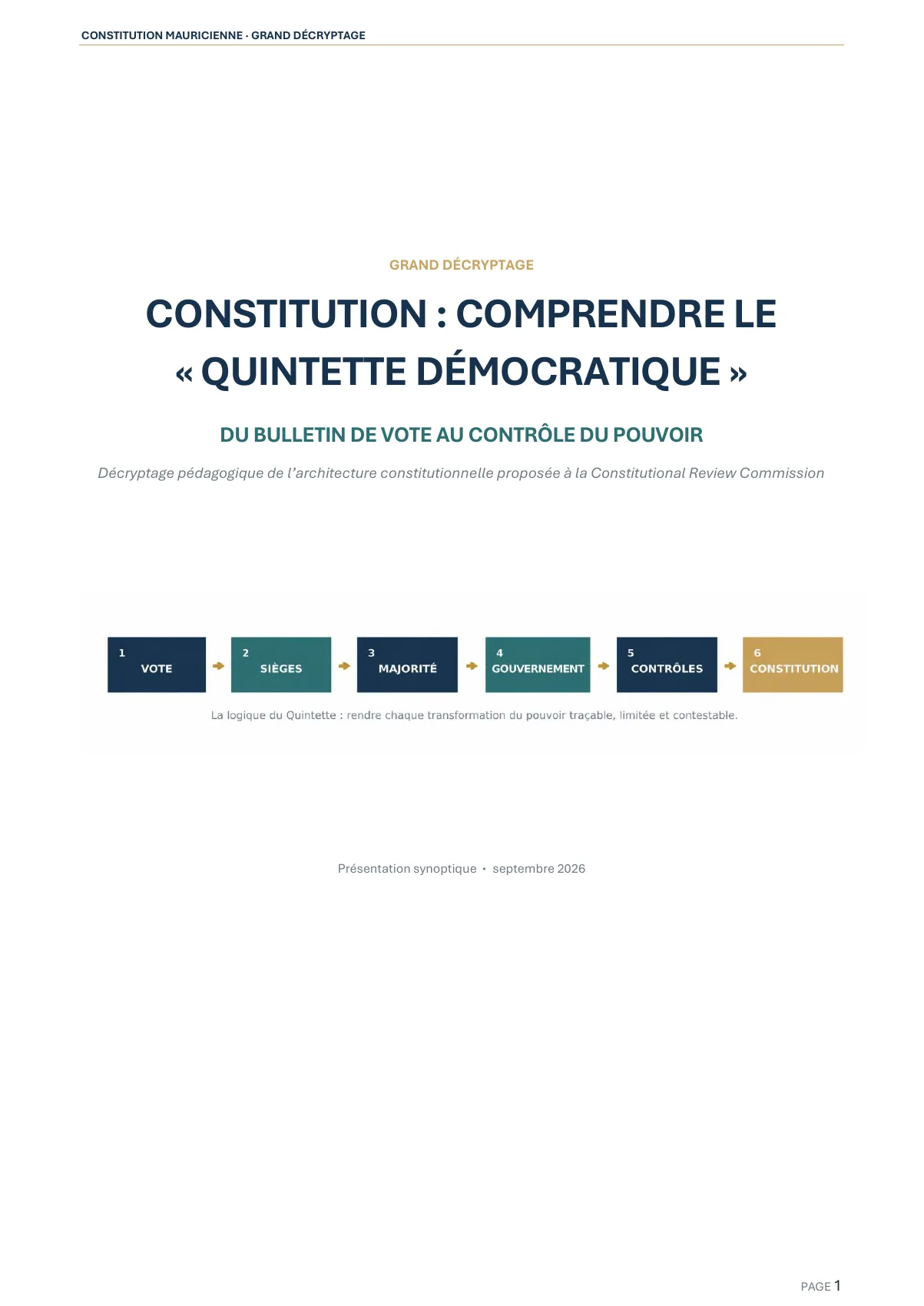
From the ballot paper to the Constitution, follow the transformation of a citizen’s voice into accountable power. The synoptic presentation offers an initial path through the Quintet’s architecture.
Begin immersive reading Enter the Quintet document collection03 / THE CONDITIONS OF CREDIBILITY
Pre-declared coalitions, constructive votes of no confidence and anti-defection rules targeted at votes determining the Government’s survival. Expulsion from a party does not, of itself, create a vacancy: an opportunity to be heard, a judicial decision and a right of appeal precede the loss of the seat.
The proposed departure from the Best Loser System is conditional upon effective replacement safeguards. Candidate selection, funding, accessibility and access to responsibility must be examined together: proportionality alone does not guarantee diversity among elected representatives.
The Canon provides for comparison with competing solutions, a 24-month preparation target and an independent audit 12–18 months after the first election under the new system. Implementation depends upon the legislation adopted, institutional capacity and operational safeguards.
Source · Consolidated Canon, executive summary, §§ 2, 6 and 10–12. The English clauses set out draft provisions and choices still requiring examination.
A CONTRIBUTION TO REFORM
The Constitutional Canon of the Democratic Quintet towards 2050, its presentation and the Draft Constitutional Clauses have been submitted to the Constitutional Review Commission as part of the constitutional and electoral reform process in Mauritius.
Deferred publication of the complete official versions. At the author’s discretion, the submitted materials will not be published in their complete official versions until the Commission has deliberated. Public presentations and developmental archives introduce the approach without replacing the dossier submitted.
The files below are the selections and publication versions supplied by the author. Their availability implies neither endorsement nor validation by the Commission. The complete official versions of the dossier remain withheld.
Choose a cover to open the full-size document and its explanation. Previews fill the available width in each document’s actual proportions, whether portrait or landscape. Titles remain fully visible.
Canon · Public selection · 16 pages
The selection prepared for publication introduces the standing, direction and reference points of the consolidated September 2026 edition.
Presentation · Public file · 9 pages
A visual path through the purposes of the consolidated proposal and its invitation to comparative examination.
Clauses · Public selection · 4 pages
The publication pages introduce the proposed legislative expression of the Canon, its standing and working references.
Submission · Public file · 4 pages
The publication file sets out the purpose of submitting the Canon and the schedule of documents sent to the Commission.
04 / YOUR PLACE IN THE DISCUSSION
Prepare an argument, identify its supporting evidence and say what might change your mind. This notebook is not a public comments space; nothing is sent automatically.
05 / FIND THE TEXTS
These archives document the proposal’s development. In the event of a discrepancy, the consolidated edition of September 2026 is authoritative.
Choose a cover to open the full-size document and its explanation. Previews fill the available width in each document’s actual proportions, whether portrait or landscape. Titles remain fully visible.
Overview · 47 pages
A visual account of the reasoning that leads from the electoral diagnosis to the five components of the Quintet.
An introductory path · 48 pages
A presentation tracing the problem, principles, five pillars and principal objections.
Institutional safeguards · 44 pages
A dossier on rules intended to prevent opportunistic changes of allegiance and allow governments to be replaced without perpetual crisis.
The full doctrine · 49 pages
The substantive text connecting the conversion of votes into seats, the distribution of powers and safeguards for stability.
An initial reference point · 1 page
A single page explaining the purpose of the five pillars before entering into technical detail.
Representation & stability · 14 pages
An examination of the project’s central relationship: representing votes, then addressing the capacity to govern as a distinct question.
Constituent initiative · 16 pages
An examination of citizens’ ability to initiate changes to constitutional rules, and of the limits of that power.
Diaspora & second chamber · 10 pages
The document proposes a relationship between citizenship beyond national borders and an institution entrusted with a second reading.
International comparison · 5 pages
A graphical comparison of the Quintet with several families of electoral systems.
History & simulations · 14 pages
An account of Mauritian elections from 1967 to 2019, accompanied by proportional-allocation simulations.
A table of choices · 4 pages
An argumentative table contrasting several reform options with the arrangements advocated by the Quintet.
Critical essay · 9 pages
An essay connecting electoral reform with the sovereignty of an island state and its resistance to the capture of power.
Public challenge · 1 page
A letter published in Le Mauricien on 28 January 2026, addressing the Prime Minister’s responsibility to undertake reform.
11 min 03 sec. The parameters in this earlier presentation may differ from the consolidated Canon of September 2026.